Sunday, May 8, 2011

The Special Meaning of Family Traditions

It is 1889. A new child is born to a young mother only 3 years in wedlock. She is not afraid. She knows what she must do. Carefully she places the birth certificate next to her marriage certificate in the family bible. She whispers thank you for my beautiful child. Turning the pages she enters a new transition in life. Many years ago long before her vows were taken she found guidance in the form of family tradition.

The Bible she holds was passed on to her by her mother along with carefully thought out words of wisdom just for her daughter, preparing her for the life ahead. She is reminded of repeated acts that would serve as a pattern for her and the next generation to come. Here lies the true intent of family tradition. It preserves the past, guides the present and paves the way for a successful future transition.

Today such traditions are still followed by like-minded family and friends. Who are they? Some are amateur genealogists, others are artists and crafts-persons, while others are not unlike the rest of us. They are traditionalists who have learned to encapsulate life lessons, teach important morsels of wisdom to their progeny all the while celebrating each of life's precious transitions one experience at a time.

In a family of two or more there is always something to teach, celebrate and reward. From first pregnancy to baby shower. From first tooth grown to first tooth pulled. From the first day of school to getting the first report card. We establish tradition to help our young see good for their hard work.

Other milestones worthy of celebration are learning to drive and getting a driver's license. Getting that first job. Advancing to college and graduation. Learning to sell ones skills on and interview and landing that dream job. From learning to dance, dating etiquette and entering courtship to proposing and announcing acceptance of marriage.

This is the special meaning of family traditions. Remembering firsts and taking the time to reward each experience. Traditional celebrations provide a way of recording milestones of growth as a result of accepting guidance from those who came before you. Such traditions teach us how to love and value both family and this precious gift we call life.

There truly is no better way to catch-up, reminisce and celebrate achievements from one generation to the next than a traditional annual family reunion event. Family reunions are one of the most meaningful, main-stay family traditions celebrated by large and small groups worldwide. From traditional gatherings at the old homestead to more creative family reunion events, families are able to keep the union strong and provide continued support to one another.

Source: http://ezinearticles.com/6194755

madagascar acl mount and blade with fire and sword tito lupus symptoms

Saturday, May 7, 2011

HBO Releases New Preview for Lady Gaga Documentary (Video)


HBO has revealed a new teaser for Lady Gaga Presents the Monster Ball Tour: At Madison Square Garden, a concert documentary set to premiere May 7.

In the emotional black and white segment, Lady Gaga sits at her dressing room mirror and talks about some of her deepest insecurities and fears.

"I still sometimes feel like a loser kid in high school," she says. "I gotta pick myself up and I have to tell myself I'm a superstar every morning so that I can get through this day and be for my fans what they need me to be."

She adds that she feels her reputation for showiness has led people to misjudge who she is.

"It hurts when I know how much authenticity and how much genuine blood is in my spirit, and how much I feel like people don't know that," she explains.

At one point, she breaks down crying as she describes the pressure to live up to her fans' expectations: "I just wanna be queen for them, and sometimes I don't feel like one," she says.

Source: http://feedproxy.google.com/~r/thr/television/~3/X1ruJ4RVBEM/hbo-releases-new-preview-lady-181733

matilda steven seagal kung fu panda megaman miami dolphins

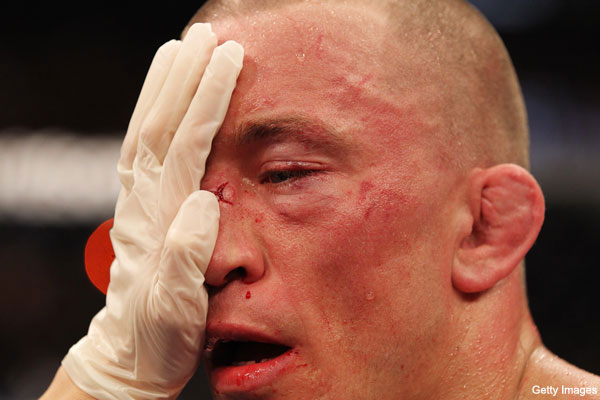
St-Pierre stumbles to finish line in victory at UFC 129

Georges St-Pierre was far from spectacular, but champions find ways to win. The UFC welterweight champ couldn't take out Jake Shields, but he had enough to survive blurred vision in his left eye and post a unanimous decision win, 48-47, 50-45 and 48-47, in the main event of UFC 129 in front of 55,000 fans at Rogers Centre in Toronto.

Even in front his home country faithful, GSP heard some boos,? jeers and whistling in the final round. Because of a damaged left eye, he struggled at times to engage over the final two rounds. He finished the fight with blood dripping down his face and a swollen eye.

"I wasn't able to see. I think it's scratched inside. I can't see with my left. I just see a blur. It's very bad," St-Pierre said during a conversation with UFC color voice Joe Rogan, as he was blinking and testing the vision out of the left.

St-Pierre, as he often does following decision victories, apologized to the massive crowd.

"His striking was much better than I thought. He closed my eyes," GSP said.

St-Pierre (22-2, 17-2 UFC) said thought he'd dominate in the standup game, "and then put and put him down later in the fight. I couldn't deliver much with this [eye]. I wanted to make a KO or submission."

St-Pierre has won nine straight fights and defended the title six times in a row. A bunch of those wins (six) have come via decision. He's a smart fighter, so he's often unwilling to take the risk required to go for the kill.

Before GSP's eye was damaged late in the third round, Shields looked silly on the feet. The former Strikeforce middleweight champ looked silly and slow. Shields (26-5-1, 1-1 UFC) is a renowned jiu-jitsu practitioner, but he never came close to scoring a takedown. He simply lacked the athleticism to catch St-Pierre.

Nelson Hamilton and Richard Bertrand posted the 48-47 scores, while Doug Crosby called it a blowout at 50-45. The FightMetric numbers tell a different story. Shields actually outlanded St-Piere 96-92, but GSP was much more accurate making good on 36.5 to 22.6 percent. Shields downfall was his inability to get the fight to the ground. He was 0-for-6 on takedown attempts while GSP put him down 2-of-3 times.

Source: http://sports.yahoo.com/mma/blog/cagewriter/post/St-Pierre-stumbles-to-finish-line-in-victory-at-?urn=mma-wp1875

hulu plus detroit lions keane 49ers thorn

Jennifer Lopez Poses With Lil Wayne On 'I'm Into You' Video Set

New photos show the pair all dressed in black and mugging for the camera on set.
By Jocelyn Vena


Jennifer Lopez and Lil Wayne
Photo: Gilly Iyer

What happens when Jennifer Lopez and Lil Wayne shoot a video together? Well, according to two new stills from the "I'm Into You" video set, the two take it very seriously and dress all in black.

In one photo, J.Lo is seen standing in a very little black dress and thigh-high boots, looking fiercely into the camera. Wayne is standing next to her, also in all black, checking the time on his watch. In another shot, the pair stands back to back, in the same outfits, both looking like they are deep in thought.

The video is set to drop on May 2, a day before J.Lo's album Love? hits the street. Previous photos from the video set show the "American Idol" judge in a much more exotic locale at Chichen Itza in Mexico.

At Chichen Itza, the singer was spotted sitting atop the steps of the historic pyramid, glaring seductively, with her legs crossed, as a camera crew hovers below her. She was wearing a long snake-print sundress with matching bracelets and headband. Another on-set photo shows Lopez in a metallic two-piece, showing her midriff and legs.

"I'm Into You" is the second single off her forthcoming album. She climbed to the top of the charts with the first single, the RedOne-produced, Pitbull-assisted dance song "On the Floor."

When she's not busy being a dance diva, Lopez is judging talent on "Idol," shopping a new reality show and gearing up to perform at the Billboard Music Awards.

Are you excited for the new J.Lo and Lil Wayne video? Tell us in the comments!

Related Artists

Source: http://www.mtv.com/news/articles/1662510/jennifer-lopez-lil-wayne-im-into-you.jhtml

nicole scherzinger rosie huntington whiteley cis peta kim kardashian

Weekly Standard: GOP Field Should Worry Democrats

Former Minnesota Governor Tim Pawlenty speaks at a Tea Party rally in Concord, New Hampshire. Pawlenty is considering a 2012 run for President.
Enlarge Darren McCollester/Getty Images

Former Minnesota Governor Tim Pawlenty speaks at a Tea Party rally in Concord, New Hampshire. Pawlenty is considering a 2012 run for President.

Darren McCollester/Getty Images

Former Minnesota Governor Tim Pawlenty speaks at a Tea Party rally in Concord, New Hampshire. Pawlenty is considering a 2012 run for President.

Jay Cost is a staff writer for The Weekly Standard.

The conventional wisdom is that the emerging Republican field for 2012 is a very weak one. However, like so much else in the topsy-turvy age of Obama, the conventional wisdom on this one is completely upside down. The idea of a weak GOP field is almost as ridiculous as a debate about a 50-year-old birth certificate just as the economic recovery comes grinding to a halt. Almost.

In fact, Obama and the Democrats have good reason to worry about the emerging Republican field. Here are four big reasons why.

(For background, check out this analysis I wrote a few weeks ago about why we should ignore the early polls on the GOP nomination battle, as well as this one on why it's normal not to have a "perfect" candidate in the field.)

1. The GOP has several serious candidates. At the moment, most of the oxygen in the nomination battle is being sucked up by less-than-viable candidates, above all Donald Trump. However, there are at least four serious contenders either in the field or looking likely to enter it: Mitch Daniels, Jon Huntsman, Tim Pawlenty, and Mitt Romney all bring a few qualities to the table that would serve them well in the general election. For starters, they're all governors, meaning their resumes involve running state governments rather than getting bogged down in the ideological divisiveness of Congress. Daniels, Pawlenty, and Romney have all demonstrated crossover appeal ? with Pawlenty and Romney winning in historically Democratic states, and Daniels winning reelection in 2008 in Indiana even as Obama carried the state. As for Huntsman's appeal, Obama was worried enough about it to ship him off to China in 2009.

Republicans should be pleased about this. Evaluating candidates is a subjective process, of course, but a cycle in which the party can point to four serious contenders who would be formidable in a general election battle is a good one.

2. An Obama-Clinton type of battle is unlikely. The battle between Barack Obama and Hillary Clinton was unprecedented in its duration, but it nevertheless has roots in historical class conflicts within the Democratic Party, with parallels to Humphrey-McCarthy in 1968, Muskie-McGovern in 1972, and Mondale-Hart in 1984. All of these battles featured a split between the party's working class constituencies that have been in place since the 1930s and the newer groups added during the 1960s.

The GOP has no such class-based divisions, dominated as it is by the married, white, church going middle class. Really, the major dividing line in the Republican Party is between moderately and very conservative voters. This means that the nominee is usually the one who can convince Republicans that he's conservative, but not so much so that he can't win a general election.

3. A "fringe" nominee is unlikely. Democrats are hoping that the Republicans nominate somebody like Barry Goldwater, who satisfied the right wing but alienated independent and moderately Republican voters in 1964. However, that has not happened since the AuH2O candidacy, in large part because primaries now dominate the nomination process. That tends to reduce the influence of the most ideologically committed voters, as a broader cross-section of the electorate participates in primaries than party caucuses. Goldwater ? who won the nomination in 1964 because of depth of support, rather than breadth ? would probably not have been able to pull it out if the rules of today had been in place back then. His victory depended on his loyal supporters taking control of state and local party organizations, but these units are no longer in charge of the nomination.

This is why, since the party reforms of the 1970s, most Republican nominees have been downright "boring." George H. W. Bush, Bob Dole, George W. Bush, and John McCain have been the selections in the last 20 years ? and even Ronald Reagan was not really an insurgent in 1980. By that point, he had served for two terms as governor of the largest state in the union, and had stood for the GOP nomination twice already. In all likelihood, the nominee in 2012 will be similar to the ones we've seen over the last 30 years.

4. An "enthusiasm gap" should not be a problem. Suppose that the GOP does nominate another candidate in line with the Bush-Dole-Bush-McCain tradition. Won't enthusiasm be a trouble spot for the party base in 2012? Probably not. The conservative base's intense dissatisfaction with the Obama tenure should be more than enough to make up for the fact that the party is not in love with the nominee (and it is possible, by the way, that the party could fall in love with somebody). On top of that, there are enough very serious figures out there who make the base swoon ? perfect for the vice presidential nomination. Marco Rubio is the first that comes to mind. Team the junior senator from Florida up with one of those serious would-be presidential nominees, set that ticket against Obama-Biden next year, and you'll have a great recipe for the most enthusiastic GOP base in decades.

Bottom line: Democrats who are counting on the GOP giving this election away with a weak nominee need to find something else to pin their hopes on. In all likelihood, it isn't going to happen, and Barack Obama will have to stand for reelection against a serious Republican ticket next year.

Source: http://www.npr.org/2011/04/29/135832662/weekly-standard-gop-field-should-worry-democrats?ft=1&f=1057

kareem abdul jabbar tupelo tom hanks willie mays samsung infuse 4g

Friday, May 6, 2011

An Oncologist's Pulitzer-Winning Cancer Biography

The Emperor of All Maladies: A Biography of Cancer
By Siddhartha Mukherjee
Hardcover, 592 pages
Scribner
List price: $30

Prologue

On the morning of May 19, 2004, Carla Reed, a thirty-year-old kindergarten teacher from Ipswich, Massachusetts, a mother of three young children, woke up in bed with a headache. "Not just any headache," she would recall later, "but a sort of numbness in my head. The kind of numbness that instantly tells you that something is terribly wrong."

Something had been terribly wrong for nearly a month. Late in April, Carla had discovered a few bruises on her back. They had suddenly appeared one morning, like strange stigmata, then grown and vanished over the next month, leaving large map-shaped marks on her back. Almost indiscernibly, her gums had begun to turn white. By early May, Carla, a vivacious, energetic woman accustomed to spending hours in the classroom chasing down five- and six-year-olds, could barely walk up a flight of stairs. Some mornings, exhausted and unable to stand up, she crawled down the hallways of her house on all fours to get from one room to another. She slept fitfully for twelve or fourteen hours a day, then woke up feeling so overwhelmingly tired that she needed to haul herself back to the couch again to sleep.

Carla and her husband saw a general physician and a nurse twice during those four weeks, but she returned each time with no tests and without a diagnosis. Ghostly pains appeared and disappeared in her bones. The doctor fumbled about for some explanation. perhaps it was a migraine, she suggested, and asked Carla to try some aspirin. The aspirin simply worsened the bleeding in Carla's white gums.

Outgoing, gregarious, and ebullient, Carla was more puzzled than worried about her waxing and waning illness. She had never been seriously ill in her life. The hospital was an abstract place for her; she had never met or consulted a medical specialist, let alone an oncologist. She imagined and concocted various causes to explain her symptoms ? overwork, depression, dyspepsia, neuroses, insomnia. But in the end, something visceral arose inside her ? a seventh sense ? that told Carla something acute and catastrophic was brewing within her body.

On the afternoon of May 19, Carla dropped her two children with a neighbor and drove herself back to the clinic, demanding to have some blood tests. Her doctor ordered a routine test to check her blood counts. As the technician drew a tube of blood from her vein, he looked closely at the blood's color, obviously intrigued. Watery, pale, and dilute, the liquid that welled out of Carla's veins hardly resembled blood.

Carla waited the rest of the day without any news. At a fish market the next morning, she received a call.

"We need to draw some blood again," the nurse from the clinic said.

"When should I come?" Carla asked, planning her hectic day. She remembers looking up at the clock on the wall. A half-pound steak of salmon was warming in her shopping basket, threatening to spoil if she left it out too long.

In the end, commonplace particulars make up Carla's memories of illness: the clock, the car pool, the children, a tube of pale blood, a missed shower, the fish in the sun, the tightening tone of a voice on the phone. Carla cannot recall much of what the nurse said, only a general sense of urgency. "Come now," she thinks the nurse said. "Come now."

I heard about Carla's case at seven o'clock on the morning of May 21, on a train speeding between Kendall Square and Charles Street in Boston. The sentence that flickered on my beeper had the staccato and deadpan force of a true medical emergency: Carla Reed/New patient with leukemia/14th Floor/Please see as soon as you arrive. As the train shot out of a long, dark tunnel, the glass towers of the Massachusetts General Hospital suddenly loomed into view, and I could see the windows of the fourteenth floor rooms.

Carla, I guessed, was sitting in one of those rooms by herself, terrifyingly alone. Outside the room, a buzz of frantic activity had probably begun. Tubes of blood were shuttling between the ward and the laboratories on the second floor. Nurses were moving about with specimens, interns collecting data for morning reports, alarms beeping, pages being sent out. Somewhere in the depths of the hospital, a microscope was flickering on, with the cells in Carla's blood coming into focus under its lens.

I can feel relatively certain about all of this because the arrival of a patient with acute leukemia still sends a shiver down the hospital's spine ? all the way from the cancer wards on its upper floors to the clinical laboratories buried deep in the basement. Leukemia is cancer of the white blood cells ? cancer in one of its most explosive, violent incarnations. As one nurse on the wards often liked to remind her patients, with this disease "even a paper cut is an emergency."

For an oncologist in training, too, leukemia represents a special incarnation of cancer. Its pace, its acuity, its breathtaking, inexorable arc of growth forces rapid, often drastic decisions; it is terrifying to experience, terrifying to observe, and terrifying to treat. The body invaded by leukemia is pushed to its brittle physiological limit ? every system, heart, lung, blood, working at the knife-edge of its performance. The nurses filled me in on the gaps in the story. Blood tests performed by Carla's doctor had revealed that her red cell count was critically low, less than a third of normal. Instead of normal white cells, her blood was packed with millions of large, malignant white cells ? blasts, in the vocabulary of cancer. Her doctor, having finally stumbled upon the real diagnosis, had sent her to the Massachusetts General Hospital.

In the long, bare hall outside Carla's room, in the antiseptic gleam of the floor just mopped with diluted bleach, I ran through the list of tests that would be needed on her blood and mentally rehearsed the conversation I would have with her. There was, I noted ruefully, something rehearsed and robotic even about my sympathy. This was the tenth month of my "fellowship" in oncology ? a two-year immersive medical program to train cancer specialists ? and I felt as if I had gravitated to my lowest point. In those ten indescribably poignant and difficult months, dozens of patients in my care had died. I felt I was slowly becoming inured to the deaths and the desolation ? vaccinated against the constant emotional brunt.

There were seven such cancer fellows at this hospital. On paper, we seemed like a formidable force: graduates of five medical schools and four teaching hospitals, sixty-six years of medical and scientific training, and twelve postgraduate degrees among us. But none of those years or degrees could possibly have prepared us for this training program. Medical school, internship, and residency had been physically and emotionally grueling, but the first months of the fellowship flicked away those memories as if all of that had been child's play, the kindergarten of medical training.

Cancer was an all-consuming presence in our lives. It invaded our imaginations; it occupied our memories; it infiltrated every conversation, every thought. And if we, as physicians, found ourselves immersed in cancer, then our patients found their lives virtually obliterated by the disease. In Aleksandr Solzhenitsyn's novel Cancer Ward, Pavel Nikolayevich Rusanov, a youthful Russian in his midforties, discovers that he has a tumor in his neck and is immediately whisked away into a cancer ward in some nameless hospital in the frigid north. The diagnosis of cancer?not the disease, but the mere stigma of its presence?becomes a death sentence for Rusanov. The illness strips him of his identity. It dresses him in a patient's smock (a tragicomically cruel costume, no less blighting than a prisoner's jumpsuit) and assumes absolute control of his actions. To be diagnosed with cancer, Rusanov discovers, is to enter a borderless medical gulag, a state even more invasive and paralyzing than the one that he has left behind. (Solzhenitsyn may have intended his absurdly totalitarian cancer hospital to parallel the absurdly totalitarian state outside it, yet when I once asked a woman with invasive cervical cancer about the parallel, she said sardonically, "Unfortunately, I did not need any metaphors to read the book. The cancer ward was my confining state, my prison.")

As a doctor learning to tend cancer patients, I had only a partial glimpse of this confinement. But even skirting its periphery, I could still feel its power?the dense, insistent gravitational tug that pulls everything and everyone into the orbit of cancer. A colleague, freshly out of his fellowship, pulled me aside on my first week to offer some advice. "It's called an immersive training program," he said, lowering his voice. "But by immersive, they really mean drowning. Don't let it work its way into everything you do. Have a life outside the hospital. You'll need it, or you'll get swallowed."

But it was impossible not to be swallowed. In the parking lot of the hospital, a chilly, concrete box lit by neon floodlights, I spent the end of every evening after rounds in stunned incoherence, the car radio crackling vacantly in the background, as I compulsively tried to reconstruct the events of the day. The stories of my patients consumed me, and the decisions that I made haunted me. Was it worthwhile continuing yet another round of chemotherapy on a sixty-six-year-old pharmacist with lung cancer who had failed all other drugs? Was is better to try a tested and potent combination of drugs on a twenty-six-year-old woman with Hodgkin's disease and risk losing her fertility, or to choose a more experimental combination that might spare it? Should a Spanish-speaking mother of three with colon cancer be enrolled in a new clinical trial when she can barely read the formal and inscrutable language of the consent forms?

Immersed in the day-to-day management of cancer, I could only see the lives and fates of my patients played out in color-saturated detail, like a television with the contrast turned too high. I could not pan back from the screen. I knew instinctively that these experiences were part of a much larger battle against cancer, but its contours lay far outside my reach. I had a novice's hunger for history, but also a novice's inability to envision it.

Excerpted from The Emperor of all Maladies: A Biography of Cancer, by Siddhartha Mukherjee. Copyright 2010 by Siddhartha Mukherjee, M.D. Excerpted with permission by Scribner, a Division of Simon & Schuster, Inc.

Source: http://www.npr.org/2011/04/22/135600761/an-oncologists-pulitzer-winning-cancer-biography?ft=1&f=1008

st louis weather origins days inn bruce springsteen jim caviezel

Remembering War Photography's Fallen Heroes [Memoriam]

In this week's app roundup: Panoramas, produced; Sword & Sworcery EP, miniaturized, slit-scan photography, discovered; mobile browsing, made social; Wikipedia, beautified; The Civil War, learned about; the wisdom of age, brought to your iPad, and much, much more. More??

Source: http://feeds.gawker.com/~r/gizmodo/full/~3/z-_ewxKgnyA/remembering-war-photographys-fallen-heroes

sathya sai baba st louis tornado charlton heston 10 commandments lupus